
Did a specific search on Google and then that truckload of ads about some item or service showed up right after? Check this out: Everything indicates that by the end of the year, you won't receive them anymore. At least, not the way you do today, due to third-party cookies.
The news is that Google started disabling this feature last Thursday, January 4th, with full removal expected by the end of 2024. It's worth noting that other competing browsers, such as Mozilla Firefox and Apple's Safari, have already been blocking third-party cookies since 2020. The argument? Privacy. This will be a gradual process and, at this first stage, will impact 1% of Chrome users. Which is already a lot of people, don't you agree?! Just look at how representative Chrome is compared to other browsers:
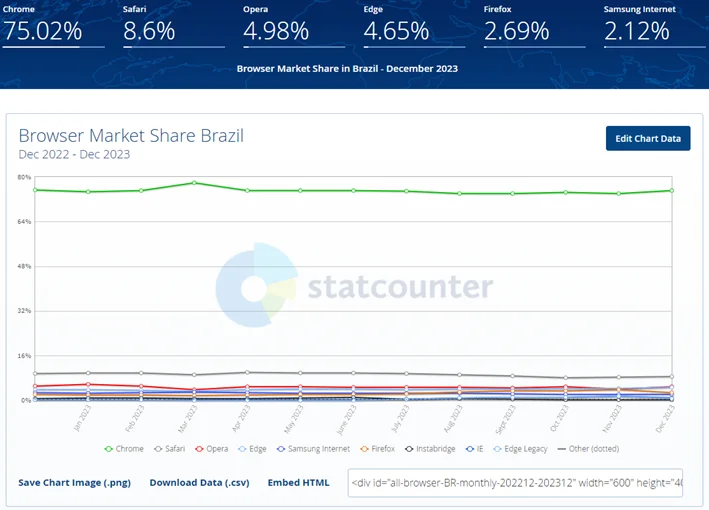
Source: Statcounter Global Sats
But, after all, what are cookies?
Come along, because On will explain what it is and what this changes in your life as a consumer and as an advertiser.
Initially, with the intention of improving people's experience based on browsing history, HTTP cookies, or internet cookies, were developed to track, personalize, and save user information during interaction with web pages (session).
Typically, this feature is enabled when we visit a new site by agreeing to its data-sharing policy. This makes it possible to do everything from creating personalized ads to saving usernames and passwords on sites that require this type of information (so you don't have to remember it every time you access it).
And what does Google plan to do as an alternative to this change?
Below are some safer actions mapped out to minimize the impact on people's experience, check it out:
- FLoC (Federated Learning of Cohorts): This is a proposal to replace third-party cookies with “cohorts”, anonymous groups of users with similar interests. This would allow advertisers to target ads based on ''interests'', rather than identifying individual users.
- TURTLEDOVE and FLEDGE: These are other technical proposals that aim to balance advertisers' needs with user privacy, allowing advertisers to carry out some targeting operations without revealing users' personal information.
- Privacy preferences page: Google has also suggested creating a page where users can see what data is being collected and even opt out of ad tracking.
It's important to reinforce that validating which (or which ones) will be adopted by Google will depend on feedback and testing carried out throughout the process of removing this feature.
Thinking from a user's perspective, this change tends to bring the following scenarios:
- Greater Privacy: Third-party cookies are often used to track user behavior across multiple sites and build interest profiles for advertising purposes. By limiting or eliminating these cookies, cross-platform tracking is reduced, which can increase user privacy.
- Fewer Unwanted Ads: With less data available to personalize ads, users may see fewer irrelevant or intrusive ads.
- Less Dependence on Tracking: The digital advertising industry may be encouraged to pursue more sustainable advertising methods that rely less on cookie tracking, which could result in more ethical and transparent business models.
- On the other hand, it's necessary to consider the downside that comes with this new scenario:
- Less Personalized User Experience: Many sites use cookies to personalize the user experience, such as remembering preferences, purchase history, or specific settings. Removing these cookies can make browsing the web less convenient.
- Reduced Revenue for Content Creators: For many sites and content creators, personalized advertising is a significant source of revenue. If tracking methods are severely limited, this could negatively affect online content monetization.
- Challenges for Small Businesses: Small businesses and advertisers that rely on targeted advertising may face challenges effectively reaching their target audience without the use of third-party cookies.
- Possible Increase in Alternative Tracking Methods: If third-party cookies are eliminated, there may be an increase in the use of alternative tracking methods, such as browser fingerprinting, which may present their own privacy challenges.
Given this, brands and agencies will need to adapt to the new reality and think of creative ways to make the transition smooth and minimize disruption, especially to the personalized content consumption experience and the impact of relevant ads for users. Some measures that should be adopted include:
- Focus on First-Party Data: Encourage your site's visitors to create accounts and fill out forms, voluntarily providing data.
- Use Alternative Technologies: Explore identity confirmation solutions based on email or authentication devices that can offer alternatives to cookie-based tracking.
- Partnerships: Consider forming partnerships with other brands to share insights, always respecting LGPD ethically and within the data-sharing rules set by law.
- Be clear about your site's data-sharing policies: By acting transparently and objectively, you greatly increase the chance of getting users to voluntarily offer their data.
- Run tests: Carry out constant testing to assess the effectiveness of your forms and data-capturing resources, always seeking the best possible experience for your audience
- Invest in SEO and Content Marketing: By efficiently reading the data collected, focus on working your communication organically, whether for an already engaged base or to expand your network in search of new users.
By adopting a proactive approach to this and other changes, brands can mitigate the impacts on their results. And you know what's the best part? Here at On, we can help you adopt these and other strategies.
Share it!
