
A few weeks ago, our dear Mark Zuckerberg signaled on his profile that we'd soon have news on Facebook. After that, the internet exploded with the possibility that the long-awaited, dreamed-of dislike button would finally exist.
To some people's dismay, Chris Cox, Chief Product Officer, soon after signaled that we'd actually get a kind of new “reactions” through emoji-likes.
The basic idea is that users have the opportunity to express their feelings more assertively about each post shared on their timeline.
It's that old story: a friend of yours shares that they lost a loved one, or that they were robbed, or any other situation where a “like” loses a bit of its meaning. That's why, to arrive at the definition of “reactions,” Facebook took into account predominant information in comments and the most used stickers on the network.
This new setup — which will be tested first by users in Spain and Ireland — will certainly enrich Facebook when it comes to behavioral data about its users. In other words, we'll become increasingly sincere and act in ways that are more faithful to our real behaviors, and consequently, we'll provide more private (and precise) information to the Company.
The market has already kicked off a broad debate about how positive, or not, this change will be for current performance measurement and reporting formats. The fact is that, very soon, there will be a range of emotional indicators available through a new toolbar.
Below, we present these upcoming emojis and what they mean for companies.
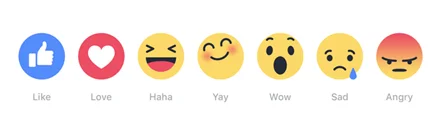
> Like
No introduction needed, since it's the current feedback tool for interactions. By default, it shows that users have shown interest in the published content.
> Love
This feedback can be interpreted as a level above Like. In other words, the company got its content strategy right. The user shows that the material touched them emotionally and that they engaged more deeply with the post.
> Haha
This will be an important indicator for more irreverent communication styles.
While companies that use the court jester archetype for content production may be concerned about getting a high volume of “hahas” on their material, companies that don't share that same vocation should raise a red flag if those numbers are high.
> Yay
It will probably be a middle ground between Like and Love. In other words, the post isn't just ok, but it's not swoon-worthy either. It will be another positive feedback indicator, since the user shows some degree of excitement about their input.
> Wow
What we can see is that this interaction will serve two opposite situations. People might be surprised by something very positive and interesting, or they might be shocked by something negative or even embarrassing.
> Sad
Among the less desired feedbacks, this one can signal disapproval of the content or the brand. If we look specifically at products and/or services, it can represent purchase frustration (“I'd really like to buy this product but I can't”).
> Angry
Without a doubt, the one most feared by brands. This emoji will give tangible shape to all the anger, frustration, or dissatisfaction with the content or the company. Naturally, more controversial topics may generate a higher volume of these reactions.
As we mentioned earlier, the absence of a dislike is notable. Although we have the Sad and Angry options, neither of them actually represents a clear dislike toward the post, brand, or person.
Facebook's concern about not upsetting its content producers (and revenue sources) is clear. Having a more aggressive disapproval option could mean a loss in the fostering of ideas and debates, since users might feel embarrassed to share their opinions or personal moments, and companies would end up with a negative indicator for their commercial efforts, making the environment more hostile for their brand's presence.
It's worth making clear that this is a perception from the international market.
That's why we ask ourselves whether these more tangible dislike indicators would actually be negative for companies or even for the communications market. Personally, I don't think so. I'd rather work with a more transparent, real scenario than breathe in subjective data.
Either way, one thing is certain: agencies need to prepare for this new scenario.
Here at On, our partner Thiago Mouço, who's in charge of the Digital Intelligence area, has already embraced this mission.
Curious to learn more about Digital Intelligence? Then click here! To check out our other services, take a look at our Solutions Page.
Come talk to us about your project and find out how we can help you achieve better results.
See you at the next update!
