
Let's be honest: traditional market research is broken. It's slow, expensive, and most of the time it asks people what they think they want, not what they actually do. Focus groups, multiple-choice surveys… these are 20th-century tools trying to solve 21st-century problems.
At SXSW 2026, it became clear that AI didn't come to fix this model. It came to rewrite it. The concept of Synthetic Customers, discussed in depth by Chad Reynolds (founder and CEO of Vurvey Labs), wasn't just another fleeting panel idea.
It was the announcement of a structural shift: real-time market simulation through autonomous agents that think and react like humans.
The panel's prediction was categorical: “In 24 months, synthetic customers will be in every marketing department.” If that doesn't scare you and excite you at the same time, you're not paying attention.
In this article, On goes beyond the hype: what this technology is, where it's already working for real, where it still falls short, and how to apply all of this to your strategy without falling into the trap of confusing one tool with another.
What Are Synthetic Customers?
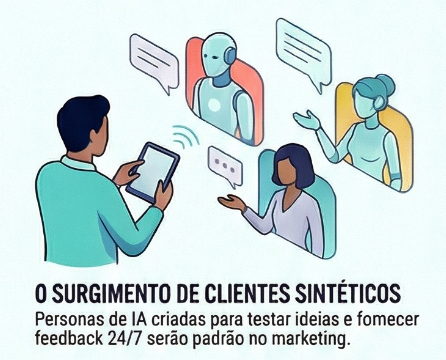
Synthetic customers (or synthetic consumers) are high-fidelity simulated personas, powered by Large Language Models (LLMs) and calibrated with real behavioral data to predict market reactions.
They're not a generic “prompt” in ChatGPT. They're data-anchored models that replicate the thought patterns, objections, desires, and pain points of a specific target audience. In practice: imagine talking to a thousand versions of your ideal customer, 24 hours a day, to validate a product name or test a campaign before spending a single cent on media.
“The brands that will win aren't the ones generating more content with AI, but the ones using AI to generate more insights.” – Chad Reynolds, Founder and CEO of Vurvey Labs
That's the game-changer. While most companies use AI for output (creating posts and videos), synthetic customers prove that the real power lies in the input: using technology to understand human behavior in depth, instead of just generating more digital noise.
The Real Case: Tropicana, Newell, and Warner Bros. Discovery
This isn't theory. But it isn't magic either, and the difference matters.
At Quirk's Chicago 2026, one of the biggest insights events in the world, executives from three giants took the stage to show how they're using synthetic customers in practice, right now: Tropicana, Newell Brands, and Warner Bros. Discovery. And the tone was refreshingly honest. It wasn't “this changes everything.” It was “we're learning, testing, and figuring out where this tool fits.”
The most concrete case came from Tropicana. Kristen DeGraaf ran a parallel test: six ads evaluated simultaneously by synthetic personas and by a human panel. The synthetic result matched the human one in five out of six. For a technology that delivers answers in hours, not weeks, and at a fraction of the cost, five out of six is a number that changes the innovation cycle game. But it's the sixth one, the one that got it wrong, that teaches the most valuable lesson.
The Anatomy of an Insight: Why AI Needs a Human
The ad that AI “got wrong” featured an orange with a red-and-white striped straw. For any human, that's instantly Tropicana, a brand asset built over decades. For the synthetic personas, the striped straw registered as… a straw. An orange. Objects, with no brand meaning embedded at all.
That's where the most brilliant point of the SXSW discussion lies: the distinction between data, observations, and insights.
AI is a machine for generating data and observations. But a true insight, the kind that produces a memorable campaign or a breakthrough product, requires something AI still doesn't have: accumulated tension and context. A powerful insight is a paradox. It's a human conflict that only your brand can resolve.
- Observation: “People use their phones while driving.”
- Insight with Tension: “People use their phones while driving because the fear of missing out (FOMO) is greater than the fear of dying.
Tropicana's striped straw is exactly that: AI sees the object, the human sees decades of meaning. It's this tension, and this cultural memory, that fuels creativity.
That's why the consensus among all three companies wasn't to replace the human. It was the opposite: use the synthetic to narrow things down, turning a long list into a short list in hours, and bring that short list to human research, where the depth happens. The human step doesn't disappear. It becomes more focused and more valuable.
Don't Confuse the Tools: The Nestlé Case (and Why It's NOT a Synthetic Customer)
Here's a distinction that separates those who understand AI from those who just repeat headlines.
Nestlé is always cited as a case of this wave, and rightly so, but for a different reason. When Nestlé anticipated the GLP-1 boom (Ozempic, Wegovy) and launched the Vital Pursuit line before competitors, it didn't use synthetic customers. It used social listening: it detected the rise in online conversations about these medications in niche communities, understood the tension (“I want to eat less, but I need to nourish myself more”) and acted fast, talking with real GLP-1 consumers to map the gaps before launching.
Social listening hears what already exists. Synthetic customers simulate what hasn't been said yet.
They're complementary disciplines, and that's where the gold is. Nestlé listened to the present. A synthetic customer would allow you to test reactions to three formulations and five packaging designs for Vital Pursuit before any of them existed. Whoever masters both fronts sees the signal and simulates the response. Confusing one with the other is the kind of mistake that weakens the authority of anyone speaking about AI.
Practical Playbook: How to Implement Synthetic Customers in Your Strategy
Waiting 24 months for this technology to become the standard means accepting the role of a follower. For
those seeking a competitive edge, the moment is now. The fundamental steps:
- Data-anchored tools: Test synthetic customer platforms that avoid the “hallucinations” of open models and ensure responses based on auditable data. Without anchoring, you're just talking to a well-dressed chatbot.
- Start with a pilot: Don't change everything at once. Pick a specific challenge, a product launch, an ad test, and build 5 to 10 synthetic customers from your CRM and the research you already have.
- Run it in parallel with humans: This is what Tropicana, Newell, and WBD did. Compare where the synthetic matches the human and, above all, where it diverges. The divergences (like the striped straw) are the map of the machine's blind spots.
- Use AI as input, not just output: Before asking AI to write a text, ask what it can tell you about the audience's hidden pain points. Technology as the foundation of strategy, not just a sentence generator.
- Build your “tension muscle”: Train your team to hunt for paradoxes in the data. Marketing gold lives in contradiction: where consumer behavior diverges from what they say is where the big opportunities appear.
Conclusion: The End of Guesswork (with Humans at the Center)
Synthetic customers put a definitive end to marketing based on gut feeling. The shift is from the old “I think this will work” to “I simulated a thousand scenarios, and I know where I need to confirm with real people.”
Notice the second half of that sentence. The promise isn't a machine that decides on its own. It's a faster, cheaper, smarter cycle, with human judgment applied at the point that matters most: finding the tension AI can't see, the striped straw that carries decades of brand meaning.
As an AI First agency, On doesn't watch this shift from a distance. We operate it. We translate SXSW's global trends into digital marketing strategy that generates measurable results for your bottom line.
If you want to apply market simulation and synthetic customers to your business, the right way, knowing how to distinguish each tool, talk to us and keep following our blog so you don't miss a single move of the future.
Also read: The End of SEO as You Know It
