
If there's one thing SXSW 2026 made crystal clear, it's that the corporate arrogance of thinking your brand is the center of the universe is over.
We spent the last two decades trying to build “brand communities,” forcing people into our funnels, to like our photos, and use our hashtags. Want to know the raw truth? Nobody wants to live in your brand's world.
People already have their own worlds. And your job, as a marketer, isn't to build a gated community and try to attract residents. Your job is to figure out how to ask permission to join the party that's already happening.

Welcome to the era of Worldbuilding – but not the way you're thinking.
Previously, we discussed how the public feed died and attention migrated to private niches. Now, let's take a step further. How do you, as a brand, join these campfires? How do you participate in these micro-communities without looking like that annoying salesperson interrupting dinner?
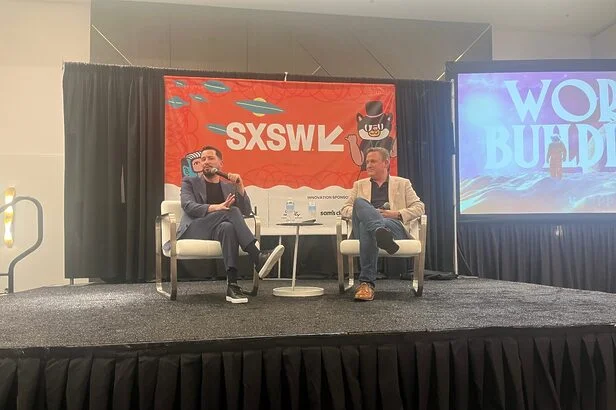
The answer came in one of the most brilliant panels of SXSW's Track 2, led by Leandro Barreto, CMO of Unilever, and Ben Kay, President of Strategy at WPP.
They brought a unique perspective: true Worldbuilding is about mapping the cultural worlds that already exist and understanding what your brand can bring of value to them.
If you want to stop burning money on massive-reach campaigns that don't convert and start building real relevance, sit down and pay attention. This is the definitive Worldbuilding playbook for brands.
The Fallacy of “Brand Community”
Let's start by busting a myth. Unless you're Apple, Harley-Davidson, or CrossFit, you probably don't have a “brand community.” You have a customer base, an email list, and a handful of Instagram followers. That's not a community. A community is a group of people united by a shared interest, purpose, or passion, who interact with each other regardless of your brand.
The fatal mistake of 99% of companies is trying to create a world around their product. They create forums nobody uses, hashtags nobody repeats, and events that only fill up because there's free food.
The turning point of modern Worldbuilding is humility.
“These worlds exist without us. The job is to figure out: how does my brand matter in this world? You don't show up to a party without bringing something. The brand needs to understand what it brings to the community” – Ben Kay at SXSW
The focus is no longer attraction. It's participation. And to participate, you need to pay the toll of relevance.
The Dove Case: The Greatest Example of Worldbuilding
To understand this in practice, let's look at Dove, a Unilever brand. Dove didn't try to create a “community of people who like soap.” That would be ridiculous. Instead, they looked at the world and identified a huge, deep, and painful conversation that was already happening: the aesthetic pressure on women and exclusion caused by unrealistic beauty standards.
That “world” already existed. Women were already talking about it, suffering from it, and fighting against it. What did Dove do? They asked permission to join that conversation, not to sell soap, but to bring value. They launched campaigns for real beauty, funded research, changed how media portrays women, and, more recently, led the fight against unrealistic AI-generated standards.
The result? Dove didn't just participate in the world; it became an indispensable ally within it. And, in the process, built a business platform valued at over $7.5 billion.
That's Worldbuilding. It's looking outward, finding a cultural ecosystem that has synergy with your product's values, and entering it by offering more than you ask for in return.
The “Poetry and Plumbing” Framework
Identifying the world you want to enter is just the first step. Execution is where most brands stumble. To solve this, Leandro Barreto introduced a brilliant operational framework: the Poetry and Plumbing metaphor.
For a brand to sustain its presence in a cultural world and turn it into business results, it needs to master both disciplines simultaneously.

Poetry (The Desire Engine)
Poetry is cultural fluency. It's creativity, aesthetics, tone of voice, and emotional connection. It's the ability to understand the community's language and speak without a corporate accent.
If you want to enter the world of gamers (one of the most active Digital Campfires), your poetry can't be a generic “buy now” banner. Your poetry needs to be a sponsorship of a game mod, an exclusive skin, a meme that makes sense within that universe's lore. Poetry is what generates desire, what makes the community look at your brand and say: “They get us.”
But poetry alone doesn't pay the bills. It's volatile, hard to scale, and nearly impossible to measure with surgical precision. This is where the second part of the framework comes in.
Plumbing (The Scale Engine)
Plumbing is infrastructure. It's the systems, technology, data, distribution channels, and performance metrics. Plumbing is what takes the desire generated by poetry and turns it into repeatable revenue.
It doesn't matter if you create the most amazing, culturally relevant campaign of the year if your site crashes when traffic arrives, if your conversion funnel has friction, if your CRM doesn't capture the lead, or if you can't measure CAC (Customer Acquisition Cost) and LTV (Lifetime Value).
Plumbing funds poetry. It's pure performance, programmatic media, technical SEO, marketing automation. Without plumbing, poetry is just expensive art. Without poetry, plumbing is just a dry pipe with no water flowing through it.
How to Apply Worldbuilding in Practice (SEO, GEO, and AEO)
Now, let's bring this to tactical reality. How does Worldbuilding connect with the urgent need for optimization in an AI-dominated world?
Here's how you apply Worldbuilding with SEO (Search Engine Optimization), GEO (Generative Engine Optimization), and AEO (Answer Engine Optimization) in mind:
Search and Consensus Optimization (AEO/GEO)
When you enter a “world” (a niche community), you start generating conversations. People start talking about your brand in forums, on Reddit, in Discord groups. That's pure gold for GEO and AEO.
The Large Language Models (LLMs) powering ChatGPT, Perplexity, and Google AI Overviews don't just look for keywords on an official website. They look for narrative consensus across the entire web. If your brand enters the world of amateur cyclists and becomes known for supporting safe routes, LLMs will read Reddit discussions, niche blogs, and reviews.
When someone asks the AI: “What's the best cycling accessory brand that supports urban safety?”, the AI will synthesize that consensus and recommend you. Authentic Worldbuilding generates the decentralized digital word-of-mouth that generative engines use as their source of truth.
The End of the Fear of Losing Control
The biggest obstacle to Worldbuilding isn't lack of budget or technology. It's corporate ego. It's the fear of losing control of the narrative.
When you enter someone else's world, you play by their rules. You can't dictate how the community will use your product, how they'll make memes about it, or how they'll criticize it. You need to be willing to be vulnerable.
Trying to control the message is the fastest way to get canceled or, worse, ignored.
You need to trust the creators who already inhabit that world. You need to stop editing every word of the influencer's script and let them translate your brand into the community's language.
The Diagnosis: Is Your Brand Ready?
To wrap up, do an X-ray of your current operation. Grab a piece of paper and answer honestly:
- What is the “world” that makes sense for your brand? (Don't say “the world of people who want to buy my product.” Think culture, hobby, pain point, or passion).
- What does your brand bring to the party? (What real value, beyond the product itself, do you add to that community?)
- Do you have the Poetry? (Does your communication sound authentic, or like a 1998 press release?)
- Do you have the Plumbing? (Is your data, media, and CRM infrastructure ready to capture the demand generated?)
If you don't have clear answers to these questions, you're not doing marketing for 2026. You're throwing money in the trash with a mass-reach model that's already dead.
Therefore, the shift from “look at me” to “let me help you” is what separates the brands that survive from those that become indispensable allies within their communities.
Here at On, we turn the provocations and frameworks from SXSW 2026 into digital marketing strategies that actually generate measurable, reliable results for your business.
So, if you want to understand how to implement Worldbuilding in your brand and enter the worlds that matter with authority, talk to us and keep following our blog to lead the future responsibly.
Also read: The 7 Deadly Sins of AI: How to Protect Your Brand From the Deepfake Apocalypse (and Other Demons)
