
If you have any social network, you've certainly seen someone posting about the protests happening across the country. No activity has had such an impact on the internet since the resounding success of the soap opera Avenida Brasil.
But how and why has it become such a powerful tool in organizing this process?
Brazil has always been one of the main references in terms of digital audience and penetration. The country is a success case for several products and relationship channels.
And on the internet, there's a word worth gold: engagement. This is nothing new – everyone knows that for something to become a viral hit, a new meme, or even materialize into a social event, this is the main element of every marketing strategy and guideline. Without the famous engagement, nothing would be effective… It would just be good images with well-crafted captions, low impact and little relevance in people's lives.
It turns out that, in the current situation, there's fuel for this engagement (whether from the government itself, the press, or other people with different ideas). At the moment of collective synapse, the biggest motivational factor of all emerges: indignation.
But how, effectively, did this “revolt” give social media a public, political and social bent? How was a good dose of patriotism and commitment injected into the country, along the lines of the “Arab Spring”? How did virtual protesters become actual demonstrators?
Historically, this type of popular action was organized by (and/or associated with) Student Movements, such as the National Union of Students (UNE), the Brazilian Union of High School Students (UBES) and the Central Student Directory (DCE), usually linked to political parties, where there's a clear, “hands-on” leadership.
Today, this kind of control is no longer necessary (after all, people's adherence and commitment come from their own free will, not from following a reference figure) and social media has become the “meeting point” for those who have felt uncomfortable with the country's political/economic direction.
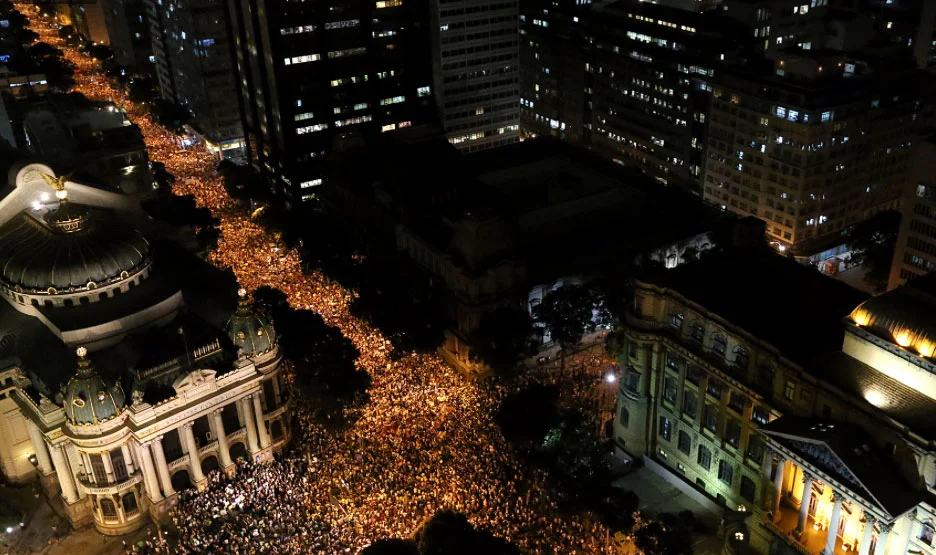
People create events, invite their friends, share videos and photos, and as a result, a sweeping sequence of marches emerges, including the major gathering on June 17th, which took place in several Brazilian states simultaneously, resulting in thousands of people protesting in the streets.
By a rough count – since reliable sources are lacking – there were more than 200,000 people present in Rio de Janeiro, 65,000 in São Paulo, 20,000 in Minas Gerais, 10,000 in Rio Grande do Sul, Paraná and the Federal District, 13,000 in Pará, 5,000 in Espírito Santo and Ceará, 4,000 in Bahia, and 2,000 in Maceió and Pernambuco. This doesn't even count other gatherings still happening across Brazilian territory and those held by Brazilians abroad.
Focusing on the “online side” of things, the numbers are extraordinary:
- On Sunday (June 16th), there were more than 6,674 tweets with the hashtag “#protestorj” starting at 4 PM;
- According to Topsy, in the last two days, there were more than 10,000 tweets with the hashtag “#changebrazil”;
- On June 17th, the hashtag “#AbaixoRedeGloboPovoNaoÉBobo” trended worldwide on Twitter, a criticism of the TV network for allegedly boycotting the protests;
- The video about how police brutality marked the protest in São Paulo, produced by Folha de São Paulo – which features the account of journalist Giuliana Vallone (hit by a rubber bullet in the eye) – has more than 1,470,000 views and 19,000 likes on YouTube;
- On Instagram, more than 7,800 photos were shared with the hashtag “#protestosp”;
- More than 136 Facebook events were created calling people to join the protests in Brazilian cities on June 17th alone. Abroad, there were 47;
- There are already more than 16,700 shares on Portal Terra's post about the protesters on the Congress ramp;
- Some expressions that went viral during the protests were taken from commercials – such as “Vem pra rua” (referencing the Fiat commercial, which already has more than 89,100 views on YouTube) and “O Gigante Acordou” (an allusion to the Johnnie Walker commercial, with more than 793,550 views on the same platform).
It's also worth highlighting the Collaborative Map developed for those interested in joining the protests. Through the site, you can see and submit reports about demonstrations happening all over Brazil, in order to alert participants about the most relevant events happening in each region.
The truth is that this is already the movement type that has had the biggest impact on the Brazilian internet, and in terms of popular mobilization, it's getting very close to reaching the milestone set by the “Caras-Pintadas” – the last major demonstration by the Brazilian people – since other gatherings are already scheduled to happen soon.
And, regardless of any personal opinion, there's no doubt that this marks a new milestone for the country, one in which the internet and its contributors can no longer be ignored. The internet has power, social media has power, and they are building a new bridge of information and interaction among the population. In this scenario, engagement is the link, and attitude is the great instrument of transformation.
